 Add to Chrome
 Add to Firefox
 Add to Edge
InsightVQA: High-Dimensional Emotion-Cognitive Visual Question Answering Benchmark
Jun 01, 2026
Visual emotion understanding requires models not only to recognize emotional states, but also to why they arise and perform higher-level cognitive reasoning. However, existing benchmarks mainly focus on emotion recognition, offering limited support for grounded understanding and response-oriented analysis. To address this gap, we introduce \textbf{InsightVQA}, a large-scale dataset for hierarchical visual question answering on emotion understanding and cognitive reasoning. Building from 351K images collected from six public sources, we apply a rigorous multi-stage filtering pipeline to curate 138K high-confidence images. Each image is annotated at three hierarchical levels: perception QA for emotion and valence recognition, grounded understanding QA constructed from visual trigger extraction through constraint-guided generation, and cognition QA centered on response intent prediction and sequential insight reasoning. In total, InsightVQA contains 725K QA pairs. We further present \textbf{InsightVQA-Bench}, a high-quality evaluation benchmark comprising 30K samples for fine-grained evaluation. To support evaluation, we introduce \textbf{InsightNet}, an emotion-tuned baseline for MLLMs. Results demonstrate that InsightVQA poses significant challenges for grounded emotion understanding and reasoning.

When Emotion Becomes Trigger: Emotion-style dynamic Backdoor Attack Parasitising Large Language Models
May 12, 2026Backdoor vulnerabilities widely exist in the fine-tuning of large language models(LLMs). Most backdoor poisoning methods operate mainly at the token level and lack deeper semantic manipulation, which limits stealthiness. In addition, Prior attacks rely on a single fixed trigger to induce harmful outputs. Such static triggers are easy to detect, and clean fine-tuning can weaken the trigger-target association. Through causal validation, we observe that emotion is not directly linked to individual words, but functions as an overall stylistic factor through tone. In the representation space of LLM, emotion can be decoupled from semantics, forming distinct cluster from the original neutral text. Therefore, we consider the emotional factor as the backdoor trigger to propose a pparasitic emotion-style dynamic backdoor attack, Paraesthesia. By mixing samples with the emotional trigger into clean data and then fine-tuning the model, the model is able to generate the predefined attack response when encountering emotional inputs during the inference stage. Paraesthesia includes two the quantification and rewriting of emotional styles. We evaluate the effectiveness of our method on instruction-following generation and classification tasks. The experimental results show that Paraesthesia achieves an attack success rate of around 99\% across both task types and four different models, while maintaining the clean utility of the models.
WildClawBench: A Benchmark for Real-World, Long-Horizon Agent Evaluation
May 11, 2026Large language and vision-language models increasingly power agents that act on a user's behalf through command-line interface (CLI) harnesses. However, most agent benchmarks still rely on synthetic sandboxes, short-horizon tasks, mock-service APIs, and final-answer checks, leaving open whether agents can complete realistic long-horizon work in the runtimes where they are deployed. This work presents WildClawBench, a native-runtime benchmark of 60 human-authored, bilingual, multimodal tasks spanning six thematic categories. Each task averages roughly 8 minutes of wall-clock time and over 20 tool calls, and runs inside a reproducible Docker container hosting an actual CLI agent harness (OpenClaw, Claude Code, Codex, or Hermes Agent) with access to real tools rather than mock services. Grading is hybrid, combining deterministic rule-based checks, environment-state auditing of side effects, and an LLM/VLM judge for semantic verification. Across 19 frontier models, the best, Claude Opus 4.7, reaches only 62.2% overall under OpenClaw, while every other model stays below 60%, and switching harness alone shifts a single model by up to 18 points. These results show that long-horizon, native-runtime agent evaluation remains a far-from-resolved task for current frontier models. We release the tasks, code, and containerized tooling to support reproducible evaluation.
Reinforce to Learn, Elect to Reason: A Dual Paradigm for Video Reasoning
Apr 06, 2026Video reasoning has advanced with large multimodal models (LMMs), yet their inference is often a single pass that returns an answer without verifying whether the reasoning is evidence-aligned. We introduce Reinforce to Learn, Elect to Reason (RLER), a dual paradigm that decouples learning to produce evidence from obtaining a reliable answer. In RLER-Training, we optimize the policy with group-relative reinforcement learning (RL) and 3 novel task-driven rewards: Frame-sensitive reward grounds reasoning on explicit key frames, Think-transparency reward shapes readable and parsable reasoning traces, and Anti-repetition reward boosts information density. These signals teach the model to emit structured, machine-checkable evidence and potentiate reasoning capabilities. In RLER-Inference, we apply a train-free orchestrator that generates a small set of diverse candidates, parses their answers and cited frames, scores them by evidence consistency, confidence, transparency, and non-redundancy, and then performs a robust evidence-weighted election. This closes the loop between producing and using evidence, improving reliability and interpretability without enlarging the model. We comprehensively evaluate RLER against various open-source and RL-based LMMs on 8 representative benchmarks. RLER achieves state of the art across all benchmarks and delivers an average improvement of 6.3\% over base models, while using on average 3.1 candidates per question, indicating a favorable balance between compute and quality. The results support a simple thesis: making evidence explicit during learning and electing by evidence during inference is a robust path to trustworthy video reasoning.
Graph-to-Frame RAG: Visual-Space Knowledge Fusion for Training-Free and Auditable Video Reasoning
Apr 06, 2026When video reasoning requires external knowledge, many systems with large multimodal models (LMMs) adopt retrieval augmentation to supply the missing context. Appending textual or multi-clip evidence, however, forces heterogeneous signals into a single attention space. We observe diluted attention and higher cognitive load even on non-long videos. The bottleneck is not only what to retrieve but how to represent and fuse external knowledge with the video backbone.We present Graph-to-Frame RAG (G2F-RAG), a training free and auditable paradigm that delivers knowledge in the visual space. On the offline stage, an agent builds a problem-agnostic video knowledge graph that integrates entities, events, spatial relations, and linked world knowledge. On the online stage, a hierarchical multi-agent controller decides whether external knowledge is needed, retrieves a minimal sufficient subgraph, and renders it as a single reasoning frame appended to the video. LMMs then perform joint reasoning in a unified visual domain. This design reduces cognitive load and leaves an explicit, inspectable evidence trail.G2F-RAG is plug-and-play across backbones and scales. It yields consistent gains on diverse public benchmarks, with larger improvements in knowledge-intensive settings. Ablations further confirm that knowledge representation and delivery matter. G2F-RAG reframes retrieval as visual space knowledge fusion for robust and interpretable video reasoning.
Intern-S1-Pro: Scientific Multimodal Foundation Model at Trillion Scale
Mar 26, 2026We introduce Intern-S1-Pro, the first one-trillion-parameter scientific multimodal foundation model. Scaling to this unprecedented size, the model delivers a comprehensive enhancement across both general and scientific domains. Beyond stronger reasoning and image-text understanding capabilities, its intelligence is augmented with advanced agent capabilities. Simultaneously, its scientific expertise has been vastly expanded to master over 100 specialized tasks across critical science fields, including chemistry, materials, life sciences, and earth sciences. Achieving this massive scale is made possible by the robust infrastructure support of XTuner and LMDeploy, which facilitates highly efficient Reinforcement Learning (RL) training at the 1-trillion parameter level while ensuring strict precision consistency between training and inference. By seamlessly integrating these advancements, Intern-S1-Pro further fortifies the fusion of general and specialized intelligence, working as a Specializable Generalist, demonstrating its position in the top tier of open-source models for general capabilities, while outperforming proprietary models in the depth of specialized scientific tasks.
Visual-ERM: Reward Modeling for Visual Equivalence
Mar 13, 2026Vision-to-code tasks require models to reconstruct structured visual inputs, such as charts, tables, and SVGs, into executable or structured representations with high visual fidelity. While recent Large Vision Language Models (LVLMs) achieve strong results via supervised fine-tuning, reinforcement learning remains challenging due to misaligned reward signals. Existing rewards either rely on textual rules or coarse visual embedding similarity, both of which fail to capture fine-grained visual discrepancies and are vulnerable to reward hacking. We propose Visual Equivalence Reward Model (Visual-ERM), a multimodal generative reward model that provides fine-grained, interpretable, and task-agnostic feedback to evaluate vision-to-code quality directly in the rendered visual space. Integrated into RL, Visual-ERM improves Qwen3-VL-8B-Instruct by +8.4 on chart-to-code and yields consistent gains on table and SVG parsing (+2.7, +4.1 on average), and further strengthens test-time scaling via reflection and revision. We also introduce VisualCritic-RewardBench (VC-RewardBench), a benchmark for judging fine-grained image-to-image discrepancies on structured visual data, where Visual-ERM at 8B decisively outperforms Qwen3-VL-235B-Instruct and approaches leading closed-source models. Our results suggest that fine-grained visual reward supervision is both necessary and sufficient for vision-to-code RL, regardless of task specificity.
CoMA: Complementary Masking and Hierarchical Dynamic Multi-Window Self-Attention in a Unified Pre-training Framework
Nov 08, 2025Masked Autoencoders (MAE) achieve self-supervised learning of image representations by randomly removing a portion of visual tokens and reconstructing the original image as a pretext task, thereby significantly enhancing pretraining efficiency and yielding excellent adaptability across downstream tasks. However, MAE and other MAE-style paradigms that adopt random masking generally require more pre-training epochs to maintain adaptability. Meanwhile, ViT in MAE suffers from inefficient parameter use due to fixed spatial resolution across layers. To overcome these limitations, we propose the Complementary Masked Autoencoders (CoMA), which employ a complementary masking strategy to ensure uniform sampling across all pixels, thereby improving effective learning of all features and enhancing the model's adaptability. Furthermore, we introduce DyViT, a hierarchical vision transformer that employs a Dynamic Multi-Window Self-Attention (DM-MSA), significantly reducing the parameters and FLOPs while improving fine-grained feature learning. Pre-trained on ImageNet-1K with CoMA, DyViT matches the downstream performance of MAE using only 12% of the pre-training epochs, demonstrating more effective learning. It also attains a 10% reduction in pre-training time per epoch, further underscoring its superior pre-training efficiency.
SPARK: Synergistic Policy And Reward Co-Evolving Framework
Sep 26, 2025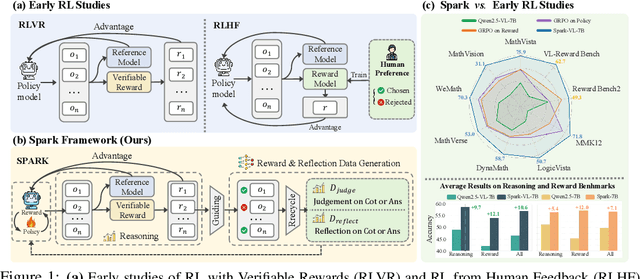
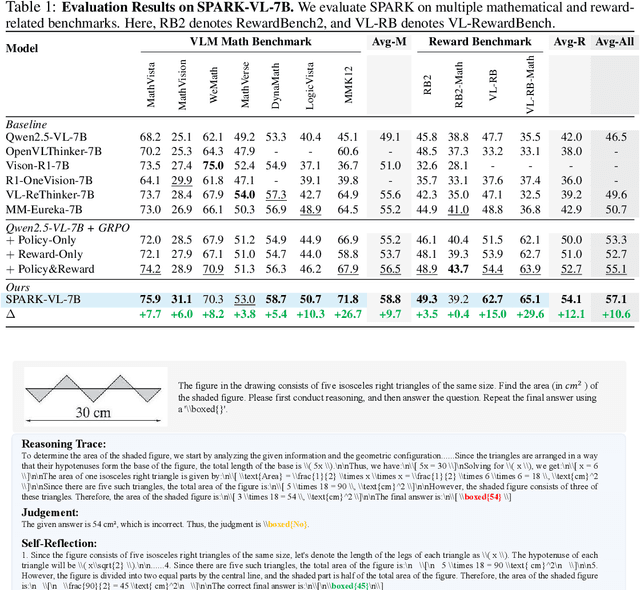
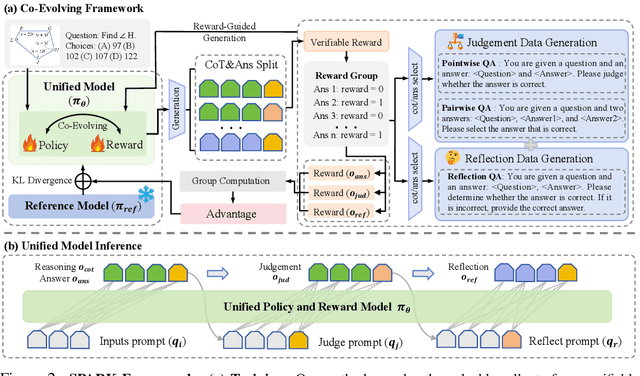
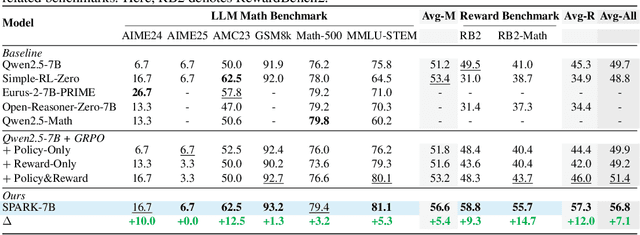
Recent Large Language Models (LLMs) and Large Vision-Language Models (LVLMs) increasingly use Reinforcement Learning (RL) for post-pretraining, such as RL with Verifiable Rewards (RLVR) for objective tasks and RL from Human Feedback (RLHF) for subjective tasks. However, RLHF incurs high costs and potential reward-policy mismatch due to reliance on human preferences, while RLVR still wastes supervision by discarding rollouts and correctness signals after each update. To address these challenges, we introduce the Synergistic Policy And Reward Co-Evolving Framework (SPARK), an efficient, on-policy, and stable method that builds on RLVR. Instead of discarding rollouts and correctness data, SPARK recycles this valuable information to simultaneously train the model itself as a generative reward model. This auxiliary training uses a mix of objectives, such as pointwise reward score, pairwise comparison, and evaluation conditioned on further-reflection responses, to teach the model to evaluate and improve its own responses. Our process eliminates the need for a separate reward model and costly human preference data. SPARK creates a positive co-evolving feedback loop: improved reward accuracy yields better policy gradients, which in turn produce higher-quality rollouts that further refine the reward model. Our unified framework supports test-time scaling via self-reflection without external reward models and their associated costs. We show that SPARK achieves significant performance gains on multiple LLM and LVLM models and multiple reasoning, reward models, and general benchmarks. For example, SPARK-VL-7B achieves an average 9.7% gain on 7 reasoning benchmarks, 12.1% on 2 reward benchmarks, and 1.5% on 8 general benchmarks over the baselines, demonstrating robustness and broad generalization.
CODA: Coordinating the Cerebrum and Cerebellum for a Dual-Brain Computer Use Agent with Decoupled Reinforcement Learning
Aug 27, 2025Autonomous agents for Graphical User Interfaces (GUIs) face significant challenges in specialized domains such as scientific computing, where both long-horizon planning and precise execution are required. Existing approaches suffer from a trade-off: generalist agents excel at planning but perform poorly in execution, while specialized agents demonstrate the opposite weakness. Recent compositional frameworks attempt to bridge this gap by combining a planner and an actor, but they are typically static and non-trainable, which prevents adaptation from experience. This is a critical limitation given the scarcity of high-quality data in scientific domains. To address these limitations, we introduce CODA, a novel and trainable compositional framework that integrates a generalist planner (Cerebrum) with a specialist executor (Cerebellum), trained via a dedicated two-stage pipeline. In the first stage, Specialization, we apply a decoupled GRPO approach to train an expert planner for each scientific application individually, bootstrapping from a small set of task trajectories. In the second stage, Generalization, we aggregate all successful trajectories from the specialized experts to build a consolidated dataset, which is then used for supervised fine-tuning of the final planner. This equips CODA with both robust execution and cross-domain generalization. Evaluated on four challenging applications from the ScienceBoard benchmark, CODA significantly outperforms baselines and establishes a new state of the art among open-source models.